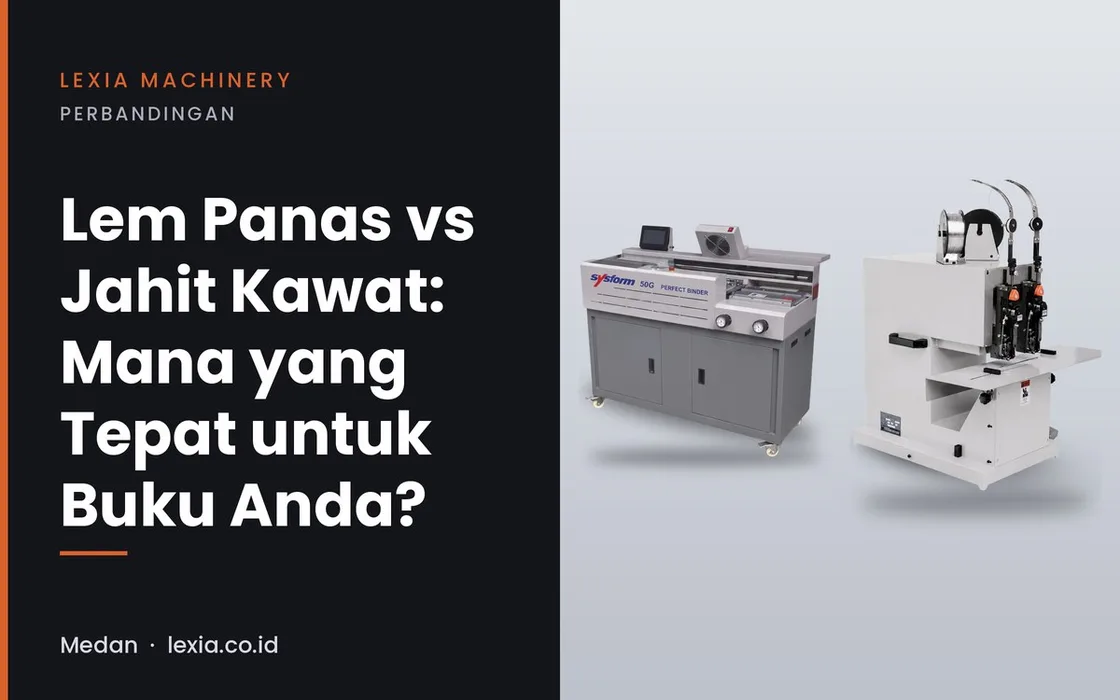
When setting up a binding line, the first two options that come up are usually hot melt glue binding (perfect binding) and wire stitching (saddle or side stitching). They solve different problems.
Hot melt glue binding
The spine is roughed up and glued with hot melt. It suits theses, annual reports, modules and thick magazines. The result is neat, with a flat spine that can carry a printed title.
- Book thickness: 40 mm to 60 mm, depending on the model.
- Speed: 200 to 480 books per hour. The F04 and 50R reach 200 books/hour, the 50B/60B 400 books/hour and the S-50G/60G 480 books/hour.
- Advantages: professional look, large page capacity, printable spine.
- Limits: needs warm-up time (for example under 25 minutes on the 50R and about 30 minutes on the 50B/60B), and very thin books are not ideal.
Wire stitching
Sheets are joined with wire through a Hohner stitching head. Ideal for booklets, notebooks and thin magazines up to about 5 mm.
- Speed: 0 to 80 cycles per minute, for example on the 801 and 802.
- Advantages: fast, low cost per unit, no warm-up.
- Limits: limited to thin books, and the spine is not flat.
Short recommendation
Print shops serving theses, reports and modules should start with a perfect binder. If your work is mostly booklets and notebooks, a wire stitcher is more economical. Many shops end up with both. To compare wire stitching models, read single head vs double head; to choose a perfect binder, read how to choose a perfect binding machine.
Decision checklist
- How thick is your product? Up to about 5 mm: wire stitching. Thicker, up to 60 mm: hot glue.
- Do you need a title on the spine? If yes, choose hot glue.
- What is the run size per order? Small and frequent runs: wire stitching, which needs no warm-up, is more practical. Large book runs: hot glue at 400–480 books/hour.
- How fast have you promised delivery? Remember hot glue needs a warm-up before production.
Frequently asked questions
What is the maximum thickness for glue binding?
Between 40 mm and 60 mm depending on the model: F04 40 mm, 50R 50 mm, and 50B/60B and S-50G/60G 60 mm.
What is the maximum thickness for wire stitching?
About 5 mm, so it suits booklets, notebooks and thin magazines.
Which is faster?
They cannot be compared directly because they serve different thicknesses. Decide your product's thickness first, then choose the method.
Browse all perfect binding machines or wire stitching machines.
"